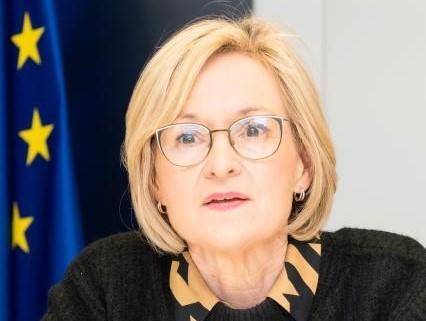
Mairead McGuinness MEP
POLICYHOLDERS LIKELY TO BE SHORT-CHANGED IN COMPENSATION SCHEME PDF  | Print |
Tuesday, 06 July 2010 12:27

Equitable Life policyholders could be short-changed by the new British Government in its forthcoming compensation scheme for policyholders, Mairead McGuinness, Ireland East Fine Gael MEP who chaired the European Parliament’s investigation into the issue said today.

The European Parliament recommended that the British Government should compensate all policyholders, including about 8,000 Irish people, in full.

McGuinness, speaking in the European Parliament in Strasbourg, said the hopes of members of the Equitable Members’ Action Group (EMAG) had been raised arising from commitments they received from the Tory party in advance of the British general election.

“Mark Hoban, the UK Financial Secretary to the Treasury has now said that the Government will be making payments to Equitable Life policyholders.  However, he also indicated that it will be for ‘relative’ loss rather than full compensation.  This is very disappointing,” she said.

Having raised the hopes of policyholders prior to the UK elections there are now fears that compensation levels may be restricted to just 20pc of losses.

"I am urging the EU Commission to press the UK Government into honouring its commitments and as chair of the Committee of Inquiry I am writing on behalf of all policyholders to the UK Government expressing our concerns that the compensation offered may fall far short of expectations.

"Some policyholders have died without compensation being paid, others have been left suffering huge financial losses and are now terrified that they will once again lose out,” said McGuinness.

The Committee of Inquiry chaired by the MEP concluded that the problems arose because Equitable Life did not set aside adequate reserves to cover its liabilities and then ran into financial difficulties when interest rates began to fall in the 1990s.  The UK's financial regulators were severely criticised for their “excessive leniency” towards the company’s inadequate reserves.

 “Our Inquiry also concluded that EU life insurance legislation was transposed into British law in an unsatisfactory fashion. This raises the question of how well EU law is transposed in all Member States and how far this process is monitored by the Commission.

“The report identified that the European Commission needs to be more pro-active when monitoring the implementation of EU law.  These issues must be addressed.  Otherwise there is a real risk that something similar will happen again,” she warned.

 
YOUNG EUROPEAN FARMERS - MCGUINNESS OUTLINES THREATS AND OPPORTUNITIES PDF  | Print |
Tuesday, 22 June 2010 13:49

Hosting a meeting of the Council for European Young Farmers (CEJA) in Brussels today (Tuesday), Mairead McGuinness, Ireland East Fine Gael MEP and member of the Agriculture Committee, said that if the future of farming is in the hands of young people we are facing a real problem with just 7% of  European farmers now under the age of 35.

“That presents a threat to the future of a vibrant and innovative farming and agriculture sector and it must be addressed,” she said.

She told the young farmers that Europe has the capacity to surmount the challenge.  “In fact Europe has all of the tools – the science, enthusiastic, well educated younger generations and perhaps as a result of extreme volatility of the markets - food markets and latterly financial markets – a now deeper appreciation of the need to develop in a sustainable way.

“Over the next 30 years demand for food is expected to double.  While that is a challenge it is also an opportunity,” she told them.

McGuinness said it is essential that there would be a strong focus on young generations to develop agriculture in an innovative and efficient way.  “In this regard a report approved by the Agricultural Committee just last week recommends investment loans to meet high start-up costs to attract young farmers, including women, into the industry. 

“It also highlights the importance of at least maintaining the agriculture budget beyond 2013 and that direct payments to farmers should be fully funded from the EU budget to avoid the implicit threat inherent with co-financing by Member States.”

The MEP said the importance of scientific innovation cannot be underestimated.  “And the drivers of this will be those under 35 years of age,” she said.  “The EU is currently the largest importer of agricultural products using a land bank of 35 million hectares of non-EU land to supply its needs. In the nine years between 1999 and 2008 Europe's use of foreign land for its own agricultural production has grown by 40pc or 10 million hectares. It is clear that each successive reform of the CAP has resulted in the EU increasing its import of food and agricultural products.  The consequences of this trend for land use change and climate change are significant,” she said.

McGuinness warned, however, that agriculture policy cannot be left to Europe alone.  “A national strategic plan for the future of agriculture is urgently needed,” she said.

The young farmers said at today’s meeting that the future of agriculture was about “people, planet and profit.”

 
DAIRY RECOMMENDATIONS – STILL DIFFICULT DECISIONS AHEAD PDF  | Print |
Wednesday, 16 June 2010 12:42

Mairead McGuinness, Ireland East Fine Gael MEP said the recommendations today (Tuesday, 15 June) from the High Level Group on Milk show how difficult it is to fashion a path for the dairy industry in a more liberalised marketplace. 

“While the establishment of the group arose from the recent milk price volatility and income collapse for dairy farmers it is primarily attempting to address key issues for the sector in the new environment following the abolition of milk quotas in 2015. 

“These recommendations require careful study.  The issue of contracts for producers is new and is not universally welcomed at farm level. However, it may be a requirement for the stability of the sector in the years ahead. 

"The problem of milk price volatility which gives rise to unacceptable dairy farm income volatility needs to be addressed and this report is seeking to do that. 

“To that end, the recommendation in relation to enhancing the bargaining power of producers is noteworthy, inviting the Commission to explore new WTO green box compatibility measures in order to reduce income volatility in the post 2013 period. 

"The report does not provide any silver bullet to the woes which hit the dairy sector recently but it is an attempt to see what measures might provide for greater stability,” she said. 

McGuinness said the need for market support measures is addressed in the report, which suggests that existing measures are appropriate. 

"I do not agree with this conclusion. The measures we have failed to prevent the dramatic price collapse that hit the sector and, therefore, more work is required on this issue. 

"Dairy farmers need some certainty about the future now and in the aftermath of milk quota abolition. 

"This report gives some pointers to the future but apart from the recommendation on contracts gives little guidance on the way ahead,” she said.

 
Joomla Templates by Joomlashack